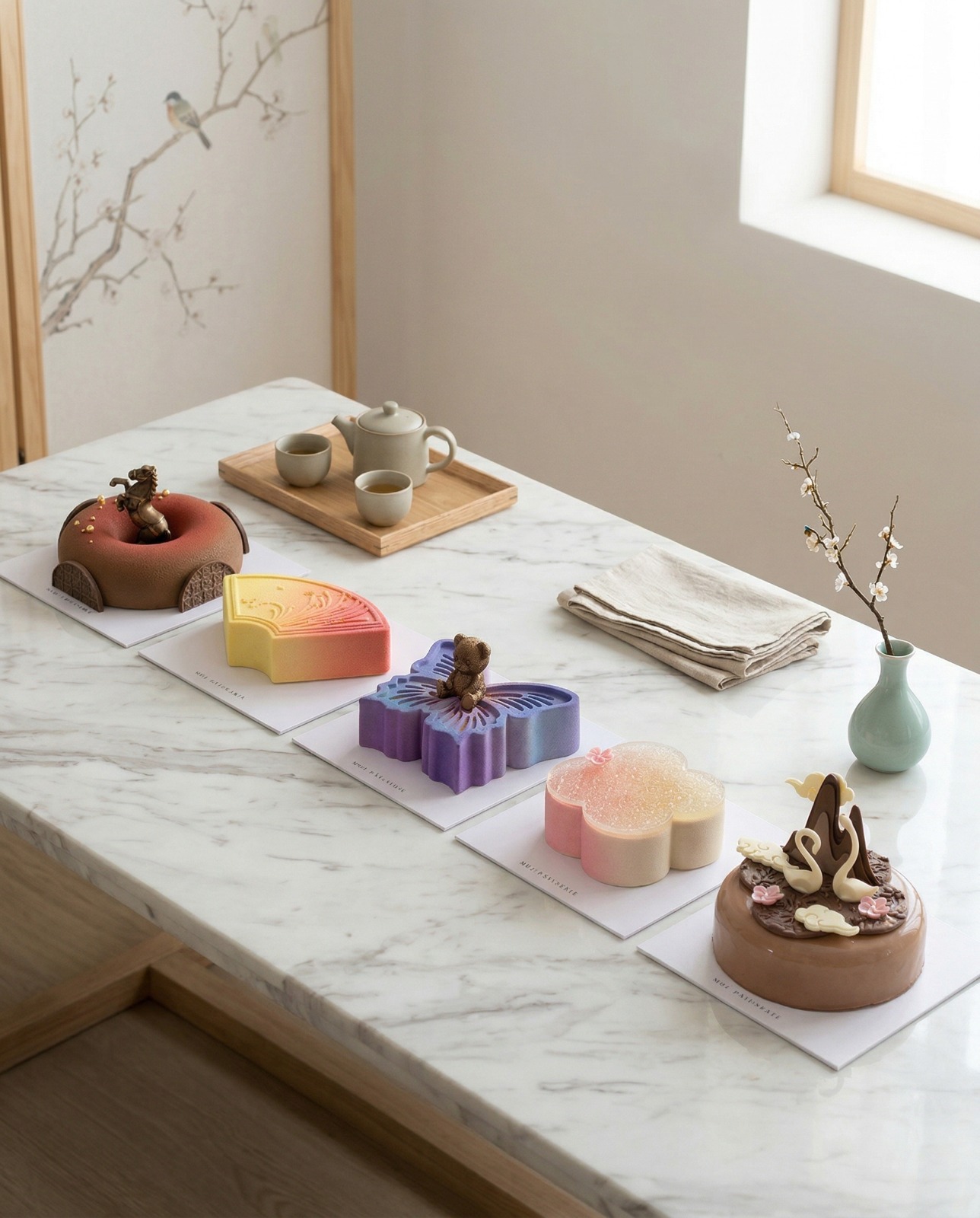
There is a moment, just before you lift the cake box lid, where anticipation feels almost unbearable. At MOF Patisserie, we believe that moment deserves to be met with something truly beautiful and something that tells a story before a single bite is taken. That story more often than not, is written in the language of chinoiserie.
You may have noticed the delicate brushwork on our whole cakes: trailing blossoms, arching branches, fantastical birds perched mid-flight, soft washes of ivory and indigo. These motifs are not simply decoration. They are part of a centuries-old artistic tradition that has captivated the Western imagination since the 1600s and one that we have fallen completely, irreversibly in love with.
The Origins of Chinoiserie
The word chinoiserie, pronounced shin-wah-ze-ree, comes from the French word for “Chinese-esque.” It describes a Western artistic style inspired by the art, design and culture of China and East Asia, reimagined through a European lens during the 17th and 18th centuries, when trade routes brought silk, porcelain, lacquerware, and hand-painted wallpapers flooding into the salons of Paris, London and beyond.
What emerged was something entirely its own: not a direct copy of Chinese art but a dreamy, romantic interpretation of it. European craftsmen and painters, enchanted by motifs they had glimpsed on imported ceramics and textiles, created their own fantastical version of the East that is full of willowy trees, exotic birds, pagodas half-hidden in mist and flowers that seemed to bloom only in imagination.
Chinoiserie became synonymous with elegance. You would find it on the walls of Versailles, on the porcelain of Wedgwood, in the lacquered furniture of Georgian manor houses. It was the aesthetic language of refinement, wonder and romance.
“Chinoiserie is the art of falling in love with a place you have never been — and painting it in the colours of a dream.”
Why It Belongs on a Cake
When we began designing the signature look of MOF Patisserie’s whole cakes, we kept returning to one question: what should a truly special cake feel like? Not just taste like, but rather feel like. We wanted our cakes to carry the same sense of quiet grandeur that you feel when you walk into a room adorned with hand-painted wallpaper, or hold a piece of fine porcelain up to the light.
Chinoiserie answered that question beautifully. Its motifs blossoms, birds, botanicals and branching trees that translate naturally to the curved surface of a cake. The soft, unhurried linework suits the delicate medium of edible paint. The colour palette, with its harmony of creams, dusty roses, sage greens and deep navy, mirrors the pastels we love in our buttercream and ganache work.
More than anything, chinoiserie carries a sense of narrative. A single panel of plum blossoms tells you something. A pair of cranes in flight tells you something more. We like to think that every MOF cake is a small painted world — one you can hold in your hands.
A Nod to Two Worlds
There is something particularly meaningful about chinoiserie for us at MOF. As a patisserie that stands at the intersection of French pastry technique and East Asian aesthetic sensibility, this art form feels like home. It is, at its core, a dialogue between two worlds, East and West, tradition and reinvention, the precise and the poetic.
That dialogue is exactly what we are having, every day, in our kitchen.
When we pipe a scroll of plum blossom in the pale blush of an early spring morning, we are honouring both the French pastry tradition that taught us the craft and the East Asian visual language that gives our work its character. The cake becomes a meeting place, a little edible object that holds both histories at once.
What to Look for in Our Designs
Next time you find yourself admiring one of our whole cakes, here are a few of the details we hope you will notice and treasure:
The negative space. In classical East Asian painting, what is not painted is as important as what is. We carry this principle into our cake design — the untouched expanse of white or cream is never emptiness. It is breath. It is balance.
The asymmetry. Chinoiserie design rarely centres its motifs formally. A branch arches in from the left; a bird perches off to one side. This quiet imbalance creates a sense of movement and life that a perfectly symmetrical design cannot.
The palette. We work largely in soft, muted tones — dusty sage, antique gold, blush rose, ink blue. These are the colours of old porcelain and hand-painted silk. They are beautiful precisely because they are not loud.
The narrative. Look closely, and you will often find that the elements on our cakes are in gentle conversation with one another. A blossom falls toward a bird below. Branches reach toward each other across the tiers. There is always a small story unfolding, if you take a moment to look.
Our whole cakes are made entirely to order and hand-decorated by our team. If you would like a chinoiserie-inspired design for your next celebration — whether a birthday, a wedding, or a quiet dinner that deserves something extraordinary — we would love to create it for you.
Every cake begins as a conversation. Let’s start one.